
The Office Worker’s Guide to Posture and Pain Prevention

Kathmandu’s rapidly growing IT sector, financial services industry, and government workforce means that hundreds of thousands of people in the Kathmandu Valley now spend 6-10 hours per day seated at a desk. This shift in working habits has created an epidemic of musculoskeletal pain — neck pain, back pain, shoulder tension, headaches, and wrist problems — that is directly linked to poor posture and poor ergonomics.
The good news is that most office-related pain is preventable and treatable. In this guide, Manual Therapy Hospital’s experts share the most important posture and ergonomic advice for Kathmandu’s desk workers — along with guidance on when professional treatment is needed.
Sitting is the new smoking. Prolonged, unbroken sitting with poor posture is one of the most significant risk factors for musculoskeletal pain in modern working populations. But it is entirely manageable with the right knowledge.
The Most Common Pain Complaints Among Kathmandu’s Office Workers
| Pain Type | Primary Cause in Office Workers |
| Lower back pain | Prolonged sitting, lumbar flexion posture, weak core muscles |
| Neck pain | Forward head posture, looking down at screens or phones |
| Upper back and shoulder pain | Rounded shoulders, elevated shoulders from keyboard use |
| Headaches | Neck tension and trigger points in the upper trapezius and suboccipital muscles |
| Wrist and forearm pain | Repetitive keyboard and mouse use, carpal tunnel pressure |
| Eye strain and fatigue | Screen glare, incorrect monitor height, poor lighting |
The Perfect Workstation Setup — A Manual Therapist’s Checklist for Kathmandu Offices
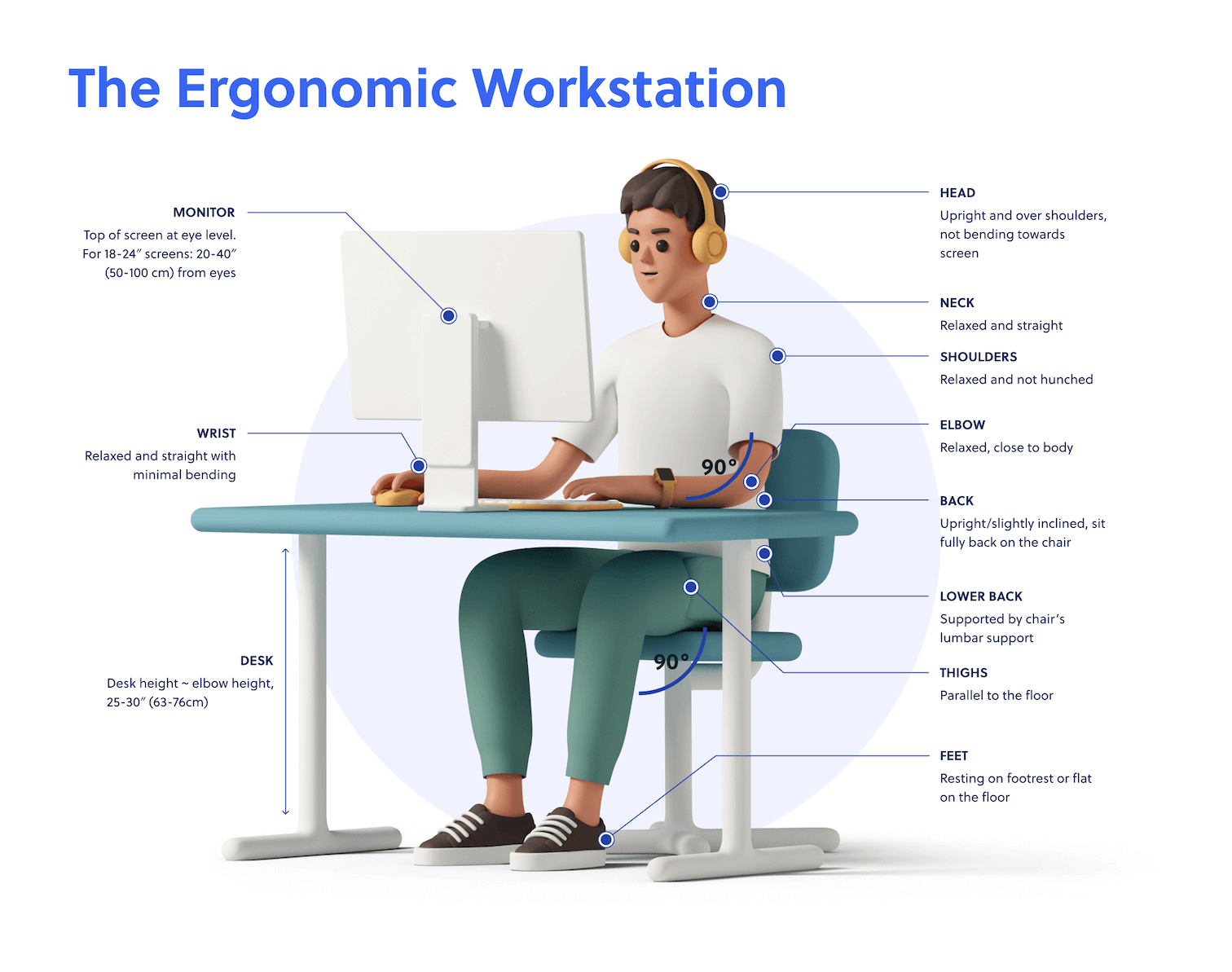
Chair and Sitting Position
- Feet flat on the floor (or on a footrest) — do not cross legs or tuck feet under the chair
- Hips at 90 degrees or very slightly open — hips should be level with or slightly higher than knees
- Lower back supported by lumbar support — use a rolled towel if your chair does not have one
- Shoulders relaxed and down — not hunched toward the ears
- Elbows at 90 degrees and close to the body when typing
Monitor and Screen Position
- Screen at eye level — the top of the monitor should be at or slightly below eye level
- Screen distance: approximately one arm’s length from your face
- No glare from windows — position the screen perpendicular to windows
- If using a laptop, use a separate keyboard and mouse and raise the laptop screen to eye level
Keyboard and Mouse
- Keyboard directly in front of you — not to one side
- Mouse within easy reach — no overreaching
- Wrists neutral while typing — not bent upward or downward
Movement Breaks
- Stand up every 30-45 minutes — even for 1-2 minutes
- Walk to get water, use stairs instead of the lift, or take standing phone calls
- Set a phone alarm every 30 minutes as a movement reminder
5 Essential Daily Exercises for Kathmandu’s Desk Workers
These exercises — recommended by our physiotherapists at Manual Therapy Hospital — take less than 10 minutes and can be done at your desk:
- Chin Tucks (Cervical Retraction): Gently tuck your chin back to create a double chin position. Hold 5 seconds, repeat 10 times. Counteracts forward head posture — the leading cause of neck pain.
- Thoracic Extension over Chair: Clasp hands behind head, gently arch back over the top of a firm chair backrest. Hold 10 seconds, repeat 5 times. Opens the chest and reverses thoracic flexion posture.
- Shoulder Blade Squeeze: Squeeze shoulder blades together and downward. Hold 5 seconds, repeat 15 times. Activates the middle trapezius and rhomboids to counteract rounded shoulders.
- Hip Flexor Stretch: Step one foot forward, lower the back knee to the floor (or kneel on a chair cushion). Push hips forward gently for 30 seconds each side. Counteracts hip flexor shortening from prolonged sitting.
- Doorway Chest Stretch: Stand in a doorway, place both forearms on the frame, and lean forward gently. Hold 30 seconds. Opens the chest and counteracts the rounded shoulder posture of desk work.
When Is Professional Treatment Needed?
Good ergonomics and daily exercises prevent most office-related pain. However, professional manual therapy and physiotherapy is needed when:
- Pain has persisted for more than 2-3 weeks despite self-care
- Pain is spreading into the arm or leg (may indicate nerve involvement)
- You are taking regular pain medication to manage work-related pain
- Pain is affecting your sleep or your ability to concentrate at work
- You have had episodes of sudden severe pain or ‘locking’ in the back or neck
Frequently Asked Questions
| Question | Answer |
| Can physiotherapy fix posture-related back pain? | Absolutely. Posture-related back and neck pain is one of the most treatable conditions at Manual Therapy Hospital. Most patients see significant improvement within 4-8 sessions combined with ergonomic changes and home exercises. |
| My employer does not have proper office chairs — what can I do? | We can advise on low-cost ergonomic modifications and provide specific exercises to compensate for poor workplace ergonomics. A rolled towel for lumbar support and a stack of books to raise your screen can make a significant difference. |
| Is posture correction treatment available at both your Kathmandu clinics? | Yes. Both our Baneshwor and Dhobighat clinics offer posture assessment, ergonomic advice, and postural rehabilitation as part of our physiotherapy services. |
| How long does posture correction take? | Structural postural changes take 8-16 weeks of regular exercise and ergonomic correction. Pain, however, typically resolves much faster — often within 4-8 physiotherapy sessions. |
Book Your Posture and Pain Assessment in Kathmandu
Do not wait for your desk job to become a chronic pain problem. Book a posture assessment at Manual Therapy M.T. Hospital — Nepal’s most experienced rehabilitation centre — and get personalised guidance and treatment today.
New Baneshwor: 9863336363 | 01-4622033
Dhobighat, Lalitpur: 9851440805 | 01-5188067
Open:
Sunday-Friday: 7:00 AM – 6:00 PM, Saturday:7:00 AM – 3:00 PM