
GFC (Growth Factor Concentrate) Therapy for Joint, Sports Injury and Orthopedic Problems in Kathmandu
**KEY FACT**
GFC (Growth Factor Concentrate) is an advanced, next-generation regenerative injection made from your own blood — but unlike PRP, it is filtered to contain only concentrated growth factors, with the red and white blood cells removed. This gives a purer, more potent regenerative signal with less post-injection inflammation. MT Hospital is now offering USG-guided (ultrasound-guided) GFC therapy for joint pain, sports injuries, and orthopedic conditions at our Baneshwor and Dhobighat clinics.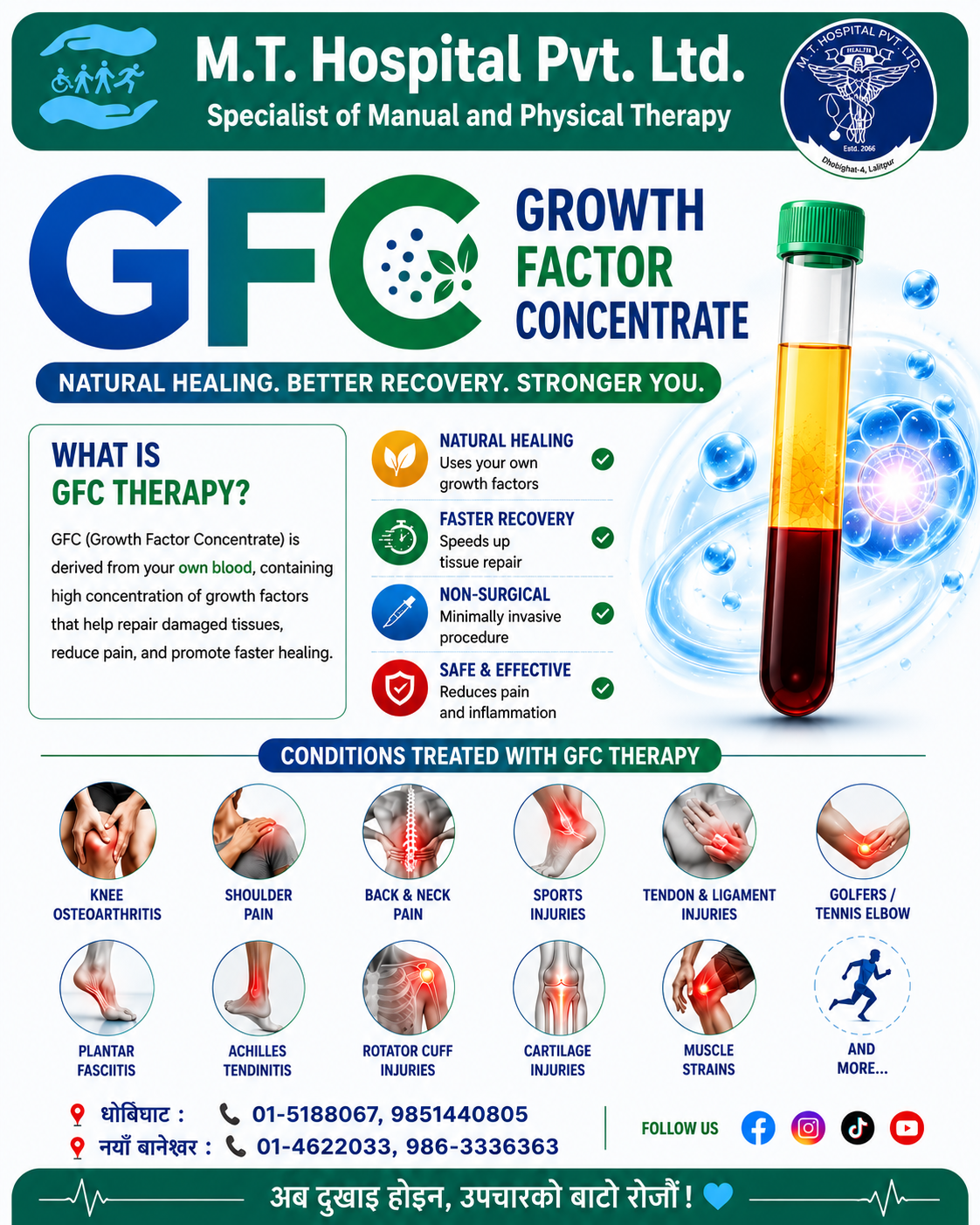
## What Is GFC Therapy?
If you have searched for “GFC in Nepal,” you have probably found dozens of clinics offering it for hair loss. That is a different application of the same underlying science. At MT Hospital, GFC is used specifically for **orthopedic and musculoskeletal conditions** — degenerating joints, damaged tendons and ligaments, and sports injuries that have not responded to rest, medication, or basic physiotherapy alone.
GFC is prepared from a small sample of your own blood. The sample is processed through a specialised centrifugation and filtration protocol that activates the platelets and then removes the cellular components — red blood cells, white blood cells, and the platelets themselves — leaving behind a clear, concentrated liquid rich in growth factors such as PDGF (platelet-derived growth factor), TGF-β (transforming growth factor beta), VEGF (vascular endothelial growth factor), and IGF (insulin-like growth factor). These are the same biological signals your body naturally uses to repair tissue, but at a far higher concentration than your blood normally contains.
Because GFC is acellular (cell-free), it carries a lower risk of the post-injection inflammatory flare that some patients experience with PRP, while still delivering the regenerative growth factor “payload” directly to the site of injury.
## How GFC Is Different From PRP
Both GFC and PRP start the same way — with a blood draw from your own arm — but they are processed differently and behave differently once injected:
– **PRP (Platelet-Rich Plasma)** concentrates the platelets themselves, along with the plasma, and injects them directly. The platelets remain intact and continue releasing growth factors gradually after the injection.
– **GFC (Growth Factor Concentrate)** goes a step further: the platelets are deliberately ruptured during processing to release their growth factors into the surrounding plasma, and the leftover cellular material (including white blood cells, which can drive inflammation) is filtered out. What is injected is a concentrated growth factor solution rather than the platelets themselves.
In practical terms, this generally means GFC delivers a higher concentration of growth factors per millilitre and tends to cause less injection-site swelling than PRP, while research has shown comparable pain and function improvement to PRP in joint conditions such as knee osteoarthritis. Your treating doctor will help you decide which option — GFC, PRP, or a combination — best fits your specific diagnosis, joint, and activity goals.
## Conditions GFC May Help
At MT Hospital, GFC is considered for patients with:
– **Early-to-moderate knee osteoarthritis** — to reduce pain and improve function and potentially slow cartilage degeneration
– **Chronic tendon injuries** — including rotator cuff tendinopathy, tennis elbow, golfer’s elbow, patellar tendinopathy (“jumper’s knee”), and Achilles tendinopathy
– **Ligament sprains and partial tears** — common in football, futsal, basketball, and trekking-related injuries
– **Frozen shoulder and shoulder joint degeneration**, used alongside manual therapy and physiotherapy
– **Hip joint pain and early avascular necrosis (AVN)**, where preserving the joint and avoiding or delaying replacement surgery is the goal
– **Sports injuries** in athletes and active individuals who need to return to training and competition without surgery and with minimal downtime
– **Other orthopedic problems** where your specialist determines regenerative injection therapy is appropriate after clinical assessment and, where needed, imaging (X-ray/MRI/ultrasound)
GFC is not suitable for every patient or every condition — advanced joint damage, certain blood disorders, active infection, and a few other factors can rule it out. This is why every GFC treatment at MT Hospital begins with a proper clinical assessment by our orthopedic and rehabilitation team, not a walk-in injection.
## The GFC Procedure at MT Hospital
1. **Consultation and assessment** — our specialists examine your joint or injury, review any imaging you have, and confirm GFC is appropriate for your condition.
2. **Blood draw** — a small, routine blood sample is taken from your arm, just like a standard blood test.
3. **Processing** — the sample undergoes centrifugation and filtration to isolate the concentrated growth factor solution.
4. **USG-guided injection** — using real-time ultrasound guidance, your physician precisely injects the GFC into the exact joint space, tendon, or ligament that needs it. This precision is what separates a properly performed regenerative injection from a “blind” one and is a core part of how MT Hospital delivers this therapy.
5. **Post-procedure guidance** — you will be given clear instructions on activity modification, and in most cases GFC is paired with a structured physiotherapy and rehabilitation plan to maximise and protect the results.
The full process typically takes around 60–90 minutes from blood draw to injection, and most patients return to light daily activity the same day or the next.
## Why Combine GFC With Physiotherapy?
A regenerative injection on its own addresses the biology of healing — but full recovery also depends on restoring strength, flexibility, and movement patterns around the joint. At MT Hospital, GFC is never offered as a stand-alone “injection and go” service. It is integrated into a complete rehabilitation programme, combining manual therapy, physiotherapy, and where appropriate, chiropractic and dry needling techniques, so the joint or tissue that has been biologically stimulated to heal is also mechanically supported and strengthened during recovery.
## Frequently Asked Questions
**Is GFC the same as the GFC used for hair loss?**
The underlying preparation process is similar, but the application is completely different. At MT Hospital, GFC is used for joints, tendons, ligaments, and sports injuries — not for hair restoration.
**Is GFC painful?**
You may feel mild discomfort during the blood draw and injection, similar to any standard injection. Ultrasound guidance helps ensure the injection is placed precisely, which can reduce unnecessary discomfort from repeated needle repositioning.
**How many sessions will I need?**
This depends on your specific condition. Some patients respond well to a single injection; chronic or more advanced conditions, such as knee osteoarthritis, may benefit from a short series of monthly injections, as is common in published clinical protocols. Your doctor will recommend a plan based on your diagnosis.
**Is GFC safe?**
Because GFC is derived from your own blood, there is no risk of allergic reaction or disease transmission from a donor source. As with any injection, there is a small risk of soreness, swelling, or bruising at the injection site, which typically resolves within a few days.
**Who performs the GFC injections at MT Hospital?**
GFC injections at our Baneshwor and Dhobighat clinics are performed by our trained medical team using ultrasound guidance for accurate placement.
**Does MT Hospital offer other regenerative options besides GFC and PRP?**
Currently, our regenerative orthopedic programme is built around GFC and PRP. We are also preparing to introduce exosome therapy specifically for joint and orthopedic conditions as our next addition — read our companion article, “PRP vs GFC vs Exosome Therapy,” for a full comparison of all three.
## Book a GFC Consultation in Kathmandu or Lalitpur
If you are dealing with a joint problem, sports injury, or orthopedic condition that hasn’t responded to rest, medication, or basic physiotherapy, GFC therapy may be worth discussing with our team. MT Hospital currently offers both GFC and PRP under ultrasound guidance at our Baneshwor clinic — your specialist will assess which is the better fit for your specific condition, or whether a combination approach makes sense. We are also preparing to introduce exosome therapy for orthopedic conditions as the next step in our regenerative programme. As Nepal’s pioneer in manual therapy since 2010, MT Hospital combines these advanced regenerative treatments with expert physiotherapy and manual therapy under one roof.
- Baneshwor Branch: Min Bhawan, New Baneshwor, Kathmandu | Tel: 01-4622033, 9863336363
*This article is for general information only and does not replace a clinical consultation. Suitability for GFC therapy is determined on a case-by-case basis by our medical team.*