
Avascular Necrosis (AVN) Treatment in Nepal: How PRP Therapy and Manual Therapy Can Save Your Joint
KEY FACTS
Avascular necrosis (AVN) is one of the most serious orthopaedic conditions affecting young and middle-aged adults in Nepal. Without early treatment, it leads to joint collapse and eventual need for total joint replacement surgery. The good news: in early-to-mid stages, PRP therapy combined with manual therapy and physiotherapy can halt disease progression and significantly restore function — without surgery. MT Hospital Kathmandu is one of the very few centres in Nepal offering this combined approach.
What is Avascular Necrosis (AVN)?
Avascular necrosis — also known as osteonecrosis or aseptic necrosis — is a serious condition in which bone tissue begins to die due to a disruption in its blood supply. When bone cells are deprived of adequate blood flow, they begin to break down. Over time, the affected bone weakens, the joint surface cracks, and eventually the bone collapses — causing severe pain and loss of joint function.
AVN most commonly affects the femoral head (the ball at the top of the thigh bone in the hip joint), but it can also affect the knee, shoulder, ankle, and wrist. In Nepal, AVN of the hip is particularly prevalent, and is one of the most common reasons patients at MT Hospital are referred for specialist treatment.
Who Gets AVN? Common Causes in Nepal
AVN can affect anyone, but in Nepal the following risk factors are most commonly seen:
- Prolonged or high-dose corticosteroid (steroid) use — the single most common cause globally. Steroids prescribed for conditions such as asthma, rheumatoid arthritis, or kidney disease can compromise bone blood supply
- Alcohol abuse — excessive alcohol consumption is a well-established cause of AVN, particularly of the femoral head
- Trauma or injury — fractures or dislocations of the hip can disrupt the blood supply to the femoral head directly
- Blood disorders — conditions such as sickle cell anaemia affect circulation and bone health
- Prolonged bed rest or immobility — reduces blood flow to weight-bearing joints
- Idiopathic (unknown cause) — in a significant proportion of cases, no clear cause is identified
- Post-COVID complications — emerging evidence links COVID-19 and steroid treatment for COVID to increased AVN risk
IMPORTANT FOR NEPALI PATIENTS
Steroid use for conditions like kidney problems, skin diseases, and rheumatic diseases is very common in Nepal — and so is AVN as a consequence. If you have been on long-term steroid treatment and are experiencing unexplained hip or knee pain, you should be evaluated for AVN immediately. Early detection is the key to avoiding surgery.
Symptoms of AVN — What to Watch For
- Deep, aching pain in the groin, hip, thigh, or buttock — often mistaken for muscle pain or sciatica in early stages
- Pain that worsens with weight-bearing (standing, walking) and improves with rest in early stages
- Gradually worsening pain even at rest as the condition progresses
- Limited range of motion in the hip or affected joint
- Limping or altered gait
- Knee pain and difficulty straightening the leg fully (in knee AVN)
- In advanced stages: severe pain that prevents normal walking and daily activities
Warning: AVN is often diagnosed late in Nepal because early-stage pain is frequently attributed to muscle strain or arthritis. If you have risk factors for AVN and experience unexplained joint pain, an MRI scan is the most sensitive early diagnostic tool.
The Four Stages of AVN (ARCO Classification)
AVN progresses through recognised stages. Understanding the stage is critical because it determines which treatments are appropriate:
| Stage | What Is Happening | Symptoms | Treatment Options |
| Stage I | Blood supply disrupted; bone cells dying, but no visible X-ray changes | Mild or no pain; often missed without an MRI | ✅ PRP + Manual Therapy + Physio (Best window) |
| Stage II | Bone density changes visible on X-ray; bone weakening but no collapse | Moderate pain; stiffness beginning | ✅ PRP + Manual Therapy + Physio (Excellent results) |
| Stage III | Crescent sign — subchondral bone beginning to collapse | Significant pain; limited movement | ⚠️ PRP + Manual Therapy may help; surgical input may be considered |
| Stage IV | Femoral head collapse; severe joint destruction | Severe constant pain; inability to walk normally | ❌ Usually requires surgery (core decompression or joint replacement) |
What is PRP Therapy and How Does It Work for AVN?
Platelet-Rich Plasma (PRP) therapy is a regenerative treatment that uses the patient’s own blood to promote healing. Here is how the process works:
- A small amount of blood is drawn from the patient’s arm — typically 15–30 ml
- The blood is placed in a centrifuge machine and spun at high speed for 8–12 minutes
- This separates the blood into layers — concentrating the platelets into a small volume of plasma
- The platelet-rich plasma is injected directly into the affected joint under ultrasound guidance (USG) for maximum precision
- The concentrated growth factors (PDGF, TGF-beta, VEGF, IGF-1) stimulate bone repair, new blood vessel formation (angiogenesis), and tissue regeneration at the AVN site
Why PRP is Particularly Effective for AVN
AVN is fundamentally a disease of inadequate blood supply to bone. PRP addresses this directly — the growth factors in PRP stimulate angiogenesis (formation of new blood vessels), helping to restore the blood supply that the necrotic bone has lost. At the same time, PRP promotes osteogenesis (new bone cell formation), helping to repair the damaged bone tissue.
Recent research published in the Indian Journal of Pain (2025) documented radiological improvement on MRI scans in early-stage AVN patients after three sessions of intra-articular PRP injections — confirming that PRP can produce measurable bone repair in addition to pain relief. A 2025 study published in BMC Musculoskeletal Disorders further confirmed PRP’s role in promoting osteogenesis in femoral head AVN.
MT HOSPITAL ADVANTAGE — USG-GUIDED PRP
Many clinics in Nepal administer PRP injections without imaging guidance (‘blind injection’). At MT Hospital, all PRP injections for AVN are performed under ultrasound guidance (USG), ensuring the plasma is delivered precisely to the affected bone. This significantly improves accuracy, safety, and clinical outcomes.
Manual Therapy and Physiotherapy for AVN — Why It Matters
PRP therapy addresses the biological and regenerative side of AVN treatment. Manual therapy and physiotherapy address the functional side — joint mobility, muscle strength, pain management, and gait restoration. Together, they form a complete, comprehensive treatment approach.
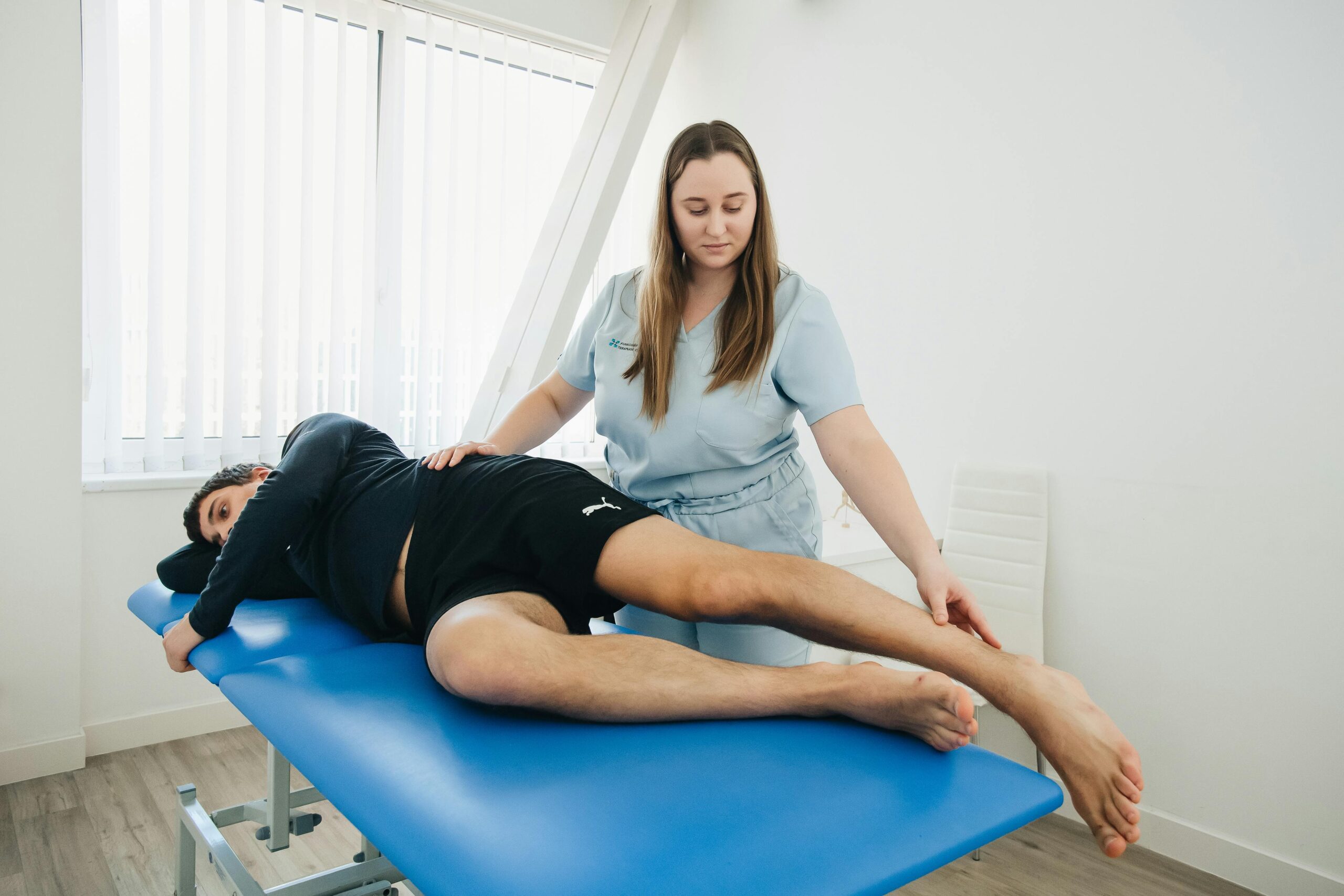
1. Joint Mobilization (Manual Therapy)
In AVN, the hip or affected joint progressively loses range of motion due to pain, inflammation, and structural changes. Manual therapy techniques — applied by our experienced therapists — gently restore joint mobility, reduce compressive forces on the damaged bone, and improve synovial fluid circulation within the joint.
2. Muscle Strengthening — Protecting the Joint
The muscles surrounding the hip (gluteus medius, gluteus maximus, hip flexors, and external rotators) play a critical protective role. When these muscles are weak — as they invariably become in patients with AVN due to pain-related disuse — the compressive load on the femoral head increases dramatically, accelerating disease progression.
Our physiotherapists design progressive, individualised strengthening programmes that protect the joint while building the muscular support needed for long-term stability.
3. Aquatic Physiotherapy (Hydrotherapy)
For AVN patients, exercising in water is particularly beneficial. The buoyancy of water reduces weight-bearing forces on the affected joint by up to 90%, allowing patients to exercise, strengthen muscles, and restore mobility without loading the damaged bone. Where available, hydrotherapy is an excellent complementary component of AVN rehabilitation.
4. Gait Training and Weight-Bearing Management
Managing how much weight goes through the affected joint during recovery is critical. Our physiotherapists provide detailed gait training, appropriate walking aid advice (crutches or walking sticks where needed), and progressive weight-bearing protocols that protect the joint while maintaining mobility.
5. Pain Management Modalities
Electrotherapy modalities including therapeutic ultrasound, TENS, and interferential therapy are used to manage pain, reduce inflammation, and improve local circulation — supporting the healing process initiated by PRP.
6. Lifestyle and Activity Modification
Certain activities accelerate femoral head loading and AVN progression. Our team provides specific guidance on activity modification — what to avoid, what is safe, and how to gradually return to normal activities as healing progresses.
The MT Hospital AVN Treatment Protocol
OUR APPROACH
At MT Hospital, we do not treat AVN with PRP alone or physiotherapy alone. We use a carefully sequenced combined protocol — PRP for biological repair and regeneration, manual therapy for joint mobility, and physiotherapy for strength and function. This multimodal approach delivers results that neither treatment achieves in isolation.
| Phase | Timing | Treatment | Goal |
| Phase 1 | Week 1–2 | Full assessment, MRI review, pain management, gentle mobilisation | Reduce pain, establish baseline, prepare for PRP |
| Phase 2 | Week 2–4 | 1st USG-guided PRP injection, gentle manual therapy, protected weight-bearing | Initiate biological repair, improve mobility |
| Phase 3 | Week 4–8 | 2nd PRP injection (if indicated), progressive physiotherapy, muscle strengthening | Continue bone regeneration, begin strength restoration |
| Phase 4 | Week 8–12 | 3rd PRP injection (if needed), advanced rehab, gait training, return to activity | Consolidate gains, restore function, prevent progression |
| Maintenance | Ongoing | Home exercise programme, periodic review, lifestyle guidance | Maintain joint health, prevent recurrence |
Can AVN Be Treated Without Surgery in Nepal?
Yes — for Stage I and Stage II AVN, and in many Stage III cases, non-surgical treatment with PRP therapy combined with physiotherapy and manual therapy can successfully halt disease progression, reduce pain, and restore function.
The critical factor is time. The earlier AVN is diagnosed and treated, the greater the likelihood of avoiding surgery. Stage IV AVN with complete femoral head collapse typically requires total hip replacement — a major surgery with significant recovery time and cost. By contrast, early-stage non-surgical treatment is far less invasive, far less expensive, and produces excellent outcomes for most patients.
RESEARCH — 2025
A case study published in the Indian Journal of Pain (June 2025) documented that three sessions of intra-articular PRP in early-stage bilateral AVN hip patients produced both clinical improvement (pain reduction, better mobility) and radiological improvement visible on MRI after 1 year — confirming PRP can stimulate measurable bone repair. A separate 2025 study in BMC Musculoskeletal Disorders confirmed that PRP promotes osteogenesis in femoral head AVN cases.
What Results Can AVN Patients Expect?
Outcomes depend on the stage of AVN at the time treatment begins:
- Stage I AVN: Excellent outcomes. Most patients experience significant pain reduction and halting of disease progression. Many achieve full functional recovery with no requirement for surgery.
- Stage II AVN: Very good outcomes. PRP combined with physiotherapy typically produces meaningful pain reduction, improved mobility, and radiological stabilisation. Surgery is avoidable for most patients.
- Stage III AVN: Moderate outcomes. Some patients respond well; others may require surgical intervention. The combination of PRP and physiotherapy can still significantly reduce pain and delay or avoid joint replacement.
- Stage IV AVN: Limited non-surgical options. At this stage, the joint surface has collapsed and surgical reconstruction is usually required. Physiotherapy is essential in post-surgical rehabilitation.
How Many PRP Sessions Are Needed for AVN?
Most AVN patients require 2–3 PRP injections, spaced 4–6 weeks apart. The protocol is individualised based on stage, severity, and the patient’s response to treatment. PRP is combined with physiotherapy sessions throughout the treatment period for maximum benefit.
Physiotherapy sessions typically run for 8–16 sessions depending on the severity of functional impairment and the patient’s rate of recovery.
Is PRP for AVN Safe?
PRP for AVN is one of the safest treatments available because:
- It uses the patient’s own blood — zero risk of rejection or allergic reaction
- No synthetic drugs are involved
- It is minimally invasive — just an injection, not surgery
- Side effects are minimal — mild soreness at the injection site for 24–48 hours is normal and expected
- Performed under ultrasound guidance at MT Hospital — minimising procedural risk
Why Choose MT Hospital for AVN Treatment in Nepal?
- Nepal’s most experienced manual therapy team — established 2011, 15+ years of orthopedic expertise
- USG-guided PRP injections — precision placement for maximum effectiveness
- Combined PRP + Manual Therapy + Physiotherapy under one roof — no need to visit multiple centers
- Two convenient locations in Kathmandu Valley — Baneshwor and Dhobighat Lalitpur
- Individualized treatment protocols — no one-size-fits-all approach
- Honest, transparent advice — if surgery is genuinely needed, we will tell you clearly
Frequently Asked Questions — AVN Treatment in Nepal
Can AVN be completely cured?
In early stages (Stage I and II), the condition can be halted, reversed, and full function restored without surgery. ‘Cure’ depends on the stage at diagnosis — which is why early detection and prompt treatment are critical.
I have been told I need a hip replacement. Is it too late for PRP?
Not necessarily. Many patients told they need hip replacement surgery actually present at Stage II or III — where non-surgical treatment still has a strong chance of success. We recommend getting a specialist assessment at MT Hospital before proceeding with surgery. A second opinion could change the entire course of your treatment.
Does PRP treatment for AVN hurt?
The injection itself is performed under local anesthesia and ultrasound guidance, so discomfort is minimal. Some patients experience mild soreness in the joint for 24–72 hours after injection, which is a normal part of the healing response.
How much does AVN treatment cost at MT Hospital?
Treatment costs depend on the number of PRP sessions required and the length of the physiotherapy program. We encourage you to call us directly about a current pricing consultation. We believe in transparent, honest pricing with no hidden costs.
Can I come from outside Kathmandu for AVN treatment?
Yes. We regularly treat patients travelling from Pokhara, Chitwan, Biratnagar, Butwal, and across Nepal. Our team can help coordinate treatment schedules to minimize travel where possible.
Contact MT Hospital for AVN Treatment
BOOK YOUR AVN ASSESSMENT TODAY
If you or a family member has been diagnosed with AVN — or is experiencing unexplained hip or knee pain with risk factors — do not wait. The earlier AVN is treated, the better the outcome and the greater the chance of avoiding surgery. M.T Hospital’s specialist team is ready to help you.
Baneshwor Branch: Min Bhawan, New Baneshwor, Kathmandu | Tel: 01-4622033 / 9863336363
Dhobighat Branch: Dhobighat-3, Lalitpur | Tel: 01-5188067 / 9851440805
Email: [email protected] | Website: www.themanualtherapy.com
Opening Hours: Sun–Fri 7:00 AM–6:00 PM | Sat 7:00 AM–3:00 PM
Pingback: Hip Pain & Hip Joint Treatment in Kathmandu | PRP Therapy & Physiotherapy at MT Hospital